
Champagne Salon – Egy pezsgőház története 1905-től napjainkig
Eugène-Aimé Salon elképzelése, a Le Mesnil-sur-Oger-i Chardonnay, az elrabolt pezsgők története, Bernard de Nonancourt és a Laurent-Perrier csoport – több mint 120 év pezsgőtörténelem.
Egy pezsgő, amely eltért a kor hagyományaitól
A Champagne Salon története 1905-ben kezdődött, amikor Eugène-Aimé Salon olyan pezsgőt alkotott, amely alapvetően különbözött a korabeli champagne-i borászat megszokott gyakorlatától.
A 20. század elején Champagne-ban a nagy pezsgőházak általában különböző szőlőfajták, termőhelyek és évjáratok házasításával készítették boraikat. Ennek célja az volt, hogy a házra jellemző stílust az eltérő évjárati adottságok mellett is fenntartsák.
Eugène-Aimé Salon ezzel szemben egyetlen szőlőfajtára, egyetlen település termőhelyeire és egyetlen évjárat termésére kívánt építeni.
Elképzelése szerint a Côte des Blancs borvidéken található Le Mesnil-sur-Oger Chardonnay szőlője önmagában is alkalmas arra, hogy hosszú érlelésű, összetett szerkezetű pezsgő készüljön belőle.
Az első Salon évjárat 1905-ben született meg. Kezdetben nem kereskedelmi céllal készítették, hanem az alapító saját fogyasztására, barátainak és vendégeinek.
A Champagne Salon később a kizárólag Chardonnay-ból készülő Blanc de Blancs pezsgők egyik legfontosabb történeti úttörőjévé vált.
A ház ma is az eredeti elképzelés fő alapelvei szerint működik: egyetlen évjáratos pezsgőt készít, kizárólag Le Mesnil-sur-Oger Chardonnay szőlőjéből, és csak akkor, ha a termés minősége megfelel az elvárásainak.
Források: Champagne Salon hivatalos története [1]; Decanter [11].
Eugène-Aimé Salon – A szőrmeipartól a pezsgőkészítésig
Eugène-Aimé Salon 1867-ben született Pocancyban, Champagne vidékén.
Családja mezőgazdasággal foglalkozott, ő azonban fiatalon Párizsba költözött, ahol a szőrmeiparban kezdett dolgozni.
A Chapal szőrmeipari vállalatnál építette fel pályafutását. Üzleti sikereinek és nemzetközi kapcsolatainak köszönhetően fokozatosan a párizsi társasági élet ismert alakjává vált.
Rendszeresen utazott, érdeklődött a gasztronómia iránt, és különösen kedvelte a jó borokat.
Bár Párizsban élt, megőrizte kapcsolatát Champagne vidékével. Amikor saját pezsgő készítését határozta el, sógora, Marcel Guillaume segítségét kérte.
Guillaume tapasztalt pincemester volt, aki jól ismerte a Côte des Blancs termőhelyeit. Együtt vizsgálták meg, mely területek alkalmasak leginkább a hosszú érlelésre szánt Chardonnay pezsgő készítéséhez.
Végül Le Mesnil-sur-Oger mellett döntöttek.
Salon elképzelése azért számított szokatlannak, mert a korabeli borászati gondolkodásban sokan úgy vélték, hogy a hosszú érlelésre elsősorban a Pinot Noir alkalmas. A Chardonnay-t gyakran túl savasnak és kevésbé tartós szerkezetűnek tekintették.
Salon éppen ennek ellenkezőjét kívánta bebizonyítani.
Úgy gondolta, hogy a megfelelő termőhelyről származó Chardonnay hosszú érlelés során képes olyan összetettséget, textúrát és szerkezetet kialakítani, amely más szőlőfajták hozzáadása nélkül is teljes értékű pezsgőt eredményez.
Az 1905-ös első évjáratot további kísérletek követték. A korai palackok rendkívül kis mennyiségben készültek, és nem kerültek kereskedelmi forgalomba.
Az alapító 1911-ben saját szőlőterületet vásárolt Le Mesnil-sur-Oger településen. Ez lett a később Le Jardin de Salon néven ismert szőlőskert.
Salon 1943-ban halt meg.
Források: Champagne Salon [1]; La Fête du Champagne / Peter Liem [9]; Decanter [11]; Club Oenologique [4].
Az első évjáratok és a kereskedelmi megjelenés
A Champagne Salon hivatalos története szerint az első évjárat 1905-ben készült, a vállalkozást pedig 1920-ban alapították meg kereskedelmi céllal.
Az első, valóban piacra szánt Salon pezsgők pontos időrendjéről a szakirodalomban kisebb eltérések találhatók.
Peter Liem Champagne-szakmai összefoglalója és több más forrás az 1921-es évjáratot nevezi meg az első kereskedelmi Salonként. A Champagne Salon hivatalos honlapja általánosabban az 1920-as évekre helyezi a kereskedelmi megjelenést.
A két dátumot ezért érdemes külön kezelni: 1905 az első elkészített évjárat, 1920 a vállalkozás hivatalos alapítása, az 1920-as évek pedig a pezsgő kereskedelmi elterjedésének időszaka.
A Maxim’s étlapja – 1928
A Salon korai történetének egyik érdekes dokumentuma a párizsi Maxim’s étterem 1928-as borlapja.
Adam Lechmere 2024. január 23-án, a Club Oenologique oldalán megjelent tanulmányában ismerteti ezt a korabeli dokumentumot.
Az étlapon az 1921-es évjáratú Salon a következő megnevezéssel szerepelt:
Salon & Cie, Mesnil Nature, Cuvée Pure de Raisins Blancs 1921, Vin de Grand Cru (Blanc de Blancs).
Ez a korabeli elnevezés azért fontos, mert mutatja, hogy a „Blanc de Blancs” fogalma ekkor még nem volt olyan általánosan használt, mint napjainkban.
A dokumentum egyúttal bizonyítja a Salon jelenlétét a párizsi gasztronómiában.
Az Union des Maisons de Champagne történeti kronológiája szerint a Salon 1928-ban a Maxim’s házpezsgőjévé vált, és különleges helyet kapott az étterem borlapján.
A Maxim’s a két világháború közötti Párizs egyik legismertebb étterme volt. A Salon ottani megjelenése jelentős szerepet játszott a pezsgő nemzetközi ismertségének kialakulásában.
Források: Club Oenologique [4]; Union des Maisons de Champagne [3].
Le Mesnil-sur-Oger – A termőhely jelentősége
A Salon kizárólag a Côte des Blancs területén található Le Mesnil-sur-Oger szőlőjéből készül.
A település ma Grand Cru besorolású, és Champagne egyik legismertebb Chardonnay-termőhelye.
A termőhelyre jellemző krétás-mészköves talaj jelentős szerepet játszik a borok szerkezetének kialakulásában.
A vastag krétarétegek képesek vizet tárolni, ugyanakkor megfelelő vízelvezetést is biztosítanak. Ez különösen fontos a szárazabb időszakokban.
A helyi Chardonnay-ból készülő borokra jellemző a határozott savszerkezet, a citrusos és zöldalmás aromavilág, valamint a mészköves, gyakran sósnak érzékelt karakter.
Ezek az adottságok különösen alkalmassá teszik a terület borait a hosszú palackos érlelésre.
A Salon egyik alapelve, hogy a különböző termőhelyek karakterét nem házasítja. A bor kizárólag Le Mesnil-sur-Oger területéről származó Chardonnay-t tartalmaz.
A húsz parcella
A Champagne Salon hivatalos adatai szerint a bor alapanyagát jelenleg húsz kiválasztott parcella biztosítja.
Ezek közül a legismertebb a pezsgőház közvetlen közelében található Le Jardin de Salon.
A ház ezt körülbelül egyhektáros saját szőlőterületként tartja nyilván. A Decanter részletesebb történeti leírása 0,77 hektáros eredeti területet említ.
A többi tizenkilenc parcelláról szerződéses szőlőtermelők révén szerzik be az alapanyagot.
Peter Liem szakmai ismertetője szerint a felhasznált szőlőterületek együttes nagysága hozzávetőleg tizenkét hektár, és a szőlőmunkák jelentős részét a Salon saját szakemberei felügyelik.
A Le Jardin de Salon legutóbbi újratelepítése 2002-ben történt.
A ház hosszú távú kapcsolata a kiválasztott parcellákkal különösen fontos a következetes borstílus fenntartása szempontjából.
A termőhelyek azonban nem maradtak minden részletükben változatlanok az elmúlt száz évben.
Források: Champagne Salon [1]; La Fête du Champagne / Peter Liem [9]; Decanter [11]; Club Oenologique [4].
A Salon és a Krug Clos du Mesnil közös története
A Salon szőlőterületeinek történetéhez kapcsolódik a Champagne egyik legérdekesebb termőhelyi változása.
A ma Krug Clos du Mesnil néven ismert, 1,84 hektáros, fallal körülvett Chardonnay-szőlőterület korábban a Salon alapanyagellátásában is szerepet játszott.
A terület a Tarin család tulajdonában volt, és innen Eugène-Aimé Salon már a kezdeti időszakban vásárolt szőlőt.
A Club Oenologique történeti cikke szerint a Clos du Mesnil az eredetileg kiválasztott Salon-parcellák egyikének számított.
1971-ben a Krug pezsgőház megvásárolta a Clos du Mesnilt.
A vásárlás dátumát a Krug vállalati története is megerősíti.
A tulajdonosváltás azonban nem jelentette feltétlenül a szőlőbeszerzés azonnali megszűnését.
A Decanter és a későbbi, Krug pincemesterével készült szakmai beszámolók alapján a Clos du Mesnil termése még az 1976-os Salon évjáratban is szerepet játszhatott.
A Krug az 1970-es évek végén kezdte el a területet saját önálló borának alapanyagaként kezelni.
Az első Krug Clos du Mesnil az 1979-es évjáratból készült, és 1986-ban került kereskedelmi forgalomba.
A Clos du Mesnil ma a Krug egyik legismertebb, önálló termőhelyről származó évjáratos pezsgője.
A két pezsgőház története tehát nemcsak földrajzilag, hanem a szőlőterületek korábbi hasznosításán keresztül is összekapcsolódik.
Ez az összefüggés egyúttal pontosítja azt a gyakran ismételt állítást, hogy a Salon napjainkban változatlanul pontosan ugyanazt a húsz parcellát használja, mint 1905-ben.
A termőhelyi alapelvek folytonossága fennmaradt, de a parcellák összetétele a történelem során módosult.
Források: Club Oenologique [4]; Krug / Moët Hennessy vállalati történet [8]; Decanter [11]; Word on the Grapevine, 2025 [17].

A pezsgőkészítés technológiája
A Champagne Salon kizárólag évjáratos Blanc de Blancs pezsgőt készít.
A bor 100% Chardonnay szőlőből származik, és minden esetben egyetlen szüret termését dolgozzák fel.
Nem használnak más szőlőfajtákat, és nem kevernek hozzá korábbi évjáratokból származó tartalékborokat.
A szőlőt a megfelelő érési állapotban szüretelik, különös figyelemmel a savtartalom, a cukorfok és az aromatikai érettség egyensúlyára.
A préselés után a legjobb minőségű mustfrakcióból készül az alapbor.
Erjesztés rozsdamentes acélban
A Champagne Salon az 1980-as évek eleje óta rozsdamentes acéltartályokat használ az alapbor erjesztéséhez.
Didier Depond a Club Oenologique interjújában elmondta, hogy ő és a korábbi borász, Alain Terrier nem tartották megfelelőnek a fahordós erjesztést a Salon stílusához.
Megítélésük szerint a fahordó háttérbe szoríthatja azt a frissességet és tiszta aromatikát, amelyet a Salon esetében meg kívántak őrizni.
A rozsdamentes acéltartályos erjesztés lehetővé teszi a hőmérséklet pontos szabályozását és a Chardonnay eredeti aromáinak hangsúlyosabb megőrzését.
Ez egyúttal fontos példa arra, hogy bár a Salon gyártási alapelvei több mint száz éve következetesek, a technológia nem maradt teljesen változatlan.
A malolaktikus erjedés mellőzése
A Salon készítésének egyik meghatározó technológiai sajátossága, hogy az alapboron nem végeznek malolaktikus erjesztést.
Ez a folyamat más boroknál az almasav egy részét tejsavvá alakítja, amely általában lágyabb savérzetet eredményez.
A Salon esetében tudatosan megőrzik az eredeti savszerkezetet.
A magasabb, feszesebb savérzet a ház megítélése szerint nélkülözhetetlen a hosszú érlelési potenciálhoz, valamint a kívánt borstílushoz.
Palackos másodlagos erjedés
Az alapbor a hagyományos champagne-i módszer szerint palackba kerül.
A palackhoz élesztőt és cukrot tartalmazó tirázslikőrt adnak, majd lezárják. A másodlagos erjedés során az élesztő a cukrot alkohollá és szén-dioxiddá alakítja.
A zárt palackban képződő szén-dioxid oldott állapotban marad, ez biztosítja a pezsgő buborékosságát.
A másodlagos erjedést követően a bor hosszú ideig az elhalt élesztősejteken, vagyis a seprőn érlelődik.
Az érlelés – Átlagosan tíz év a pincében
A Champagne Salon hivatalos adatai szerint a borokat átlagosan tíz éven keresztül érlelik a pincében.
Ez nem jelenti azt, hogy minden évjárat pontosan tíz év után kerül forgalomba.
Bizonyos évjáratok ennél hosszabb időt igényelnek, és a ház a bor fejlődésének megfelelően dönt a degorzsálásról, illetve a piaci megjelenésről.
A hosszú seprőn tartás során az élesztősejtek fokozatos lebomlása összetettebb aromatikát, finomabb textúrát és mélyebb szerkezetet alakíthat ki.
A Salon hosszú érlelésének fontos feltétele a Le Mesnil-sur-Oger-i Chardonnay természetes savszerkezete.
Az érlelési folyamat végén a seprőt a palack nyakába gyűjtik, majd degorzsálással eltávolítják.
Dosage – Visszafogott cukoradagolás
A Salon hagyományosan alacsony dosage-t, vagyis visszafogott mennyiségű expedíciós likőrt alkalmaz.
Didier Depond a Club Oenologique interjújában 5–7 gramm/liter közötti értéket említett.
Ez lehetővé teszi, hogy a bor megtartsa feszes savszerkezetét, miközben a dosage segít kiegyensúlyozni az összhatást.
A végeredmény olyan pezsgő, amelyre fiatalon gyakran citrusos, fehér virágos, sós-mészköves karakter, hosszabb érlelés után pedig összetettebb, pirított, mézes és érett gyümölcsös jegyek lehetnek jellemzők.
Források: Champagne Salon [1]; Club Oenologique, Didier Depond interjúja [4]; Decanter [11].

A termelés – Kevés évjárat, korlátozott palackszám
A Champagne Salon egyik legfontosabb sajátossága, hogy nem készül minden évben.
A ház kizárólag akkor palackoz Salont, amikor a szőlő minősége és a bor szerkezete hosszú távon is megfelel az elvárásoknak.
A 20. században mindössze 37 Salon-évjárat készült.
Ez átlagosan évtizedenként 3,7 évjáratot jelent.
A 21. század első negyedében nyolc olyan évjárat került forgalomba, amelyet a Salon saját nevén jelentetett meg: 2002, 2004, 2006, 2007, 2008, 2012, 2013 és 2015.
A Salon 2015 a pezsgőház hivatalos nyilvántartása szerint a 45. megjelent évjárat.
A termelés nagysága évjáratonként változik.
A Club Oenologique és más szakmai források szerint egy jelentősebb évjárat esetében is legfeljebb körülbelül 60 000 normál palackról beszélhetünk.
Ez nem éves állandó termelési adat, és nem azt jelenti, hogy minden évjáratból ennyi készül.
A tényleges mennyiség sokszor jóval kisebb.
A 2008-as évjárat különleges kiadása
A 2008-as Salon az egyik legjobb példa arra, milyen mértékben eltérhet a termelés az általános gyakorlattól.
A ház ebből az évjáratból mindössze 8000 magnum palackot készített.
A bort kizárólag 1,5 literes magnum formátumban palackozták, és egyedi gyűjtői összeállítás részeként forgalmazták.
Az úgynevezett Salon Le Mesnil Oenothèque Case egy 2008-as magnumot, valamint két-két 2004-es, 2006-os és 2007-es normál palackot tartalmazott.
A magnum formátum alkalmazását a ház a lassabb, kiegyensúlyozottabb palackos érleléssel indokolta.
A 2014-es és 2015-ös évjárat eltérő időrendje
A 2026-os Decanter-szakmai beszámoló szerint a Salon 2014-es évjárata hosszabb seprőn tartást igényelt, ezért a ház a 2015-ös évjáratot korábban hozta forgalomba.
Ez ritka, de nem példa nélküli döntés a Salon történetében.
A 2012, 2013, 2014 és 2015 évjáratok együttesen különleges időszakot alkotnak. A ház történetében korábban csak az 1946–1949 közötti négy egymást követő évben készült ilyen sorozat.
Az eltérő érlelési idő jól mutatja, hogy a Salon esetében nem a naptári év határozza meg a forgalomba hozatalt, hanem az adott bor fejlődése.
Mi történik a szőlővel a nem megfelelő évjáratokban?
Azokban az években, amikor nem készül Salon, a kiválasztott területek szőlője más pezsgők alapanyagaként hasznosulhat.
Ezek közül a legfontosabb a Champagne Delamotte, amely ugyanabban a településben működik, és a Laurent-Perrier csoporthoz tartozik.
A szőlő egy része a Delamotte pezsgőkbe kerülhet, más része a cégcsoport további termékeihez használható fel.
A Salon így nem kényszerül arra, hogy minden évben saját neve alatt forgalmazzon pezsgőt.
Források: Champagne Salon hivatalos évjárat-nyilvántartása [1]; Club Oenologique [4]; Decanter, 2026 [12]; Vinous [18]; La Fête du Champagne [9].
A második világháború – Az elrabolt Champagne Salon
A Champagne Salon történetének egyik legérdekesebb és egyben leggyakrabban félreértelmezett fejezete a második világháborúhoz kapcsolódik.
1940-ben, Franciaország német megszállását követően a náci hatóságok jelentős mennyiségű francia bort és pezsgőt sajátítottak ki.
A német hadsereg és a megszálló hatóságok számára Bordeaux, Burgundia és Champagne értékes készletei különösen fontos zsákmányt jelentettek.
A Champagne Salon sem kerülte el a rekvirálásokat.
A történet későbbi főszereplője Bernard de Nonancourt volt, aki a háború után a Laurent-Perrier meghatározó vezetőjévé vált.
Bernard de Nonancourt katonai szolgálata
Bernard de Nonancourt 1920-ban született.
Édesanyja, Marie-Louise de Nonancourt 1939-ben vásárolta meg a Laurent-Perrier pezsgőházat.
A második világháború kitörése után Bernard és idősebb testvére, Maurice részt vettek a francia ellenállásban.
Maurice német fogságba esett, és a Sachsenhausen-Oranienburg koncentrációs táborban halt meg.
Bernard túlélte a háborút, majd Philippe Leclerc tábornok híres 2. páncéloshadosztályában szolgált.
A Laurent-Perrier hivatalos éves jelentése szerint a 501. harckocsiezred őrmestere volt.
1945 májusában alakulatával Berchtesgaden körzetébe érkezett, ahol Adolf Hitler bajorországi rezidenciái és a náci vezetés több létesítménye is található volt.
A berchtesgadeni borospince felfedezése
A Laurent-Perrier 2011–2012-es hivatalos éves jelentésének 5. oldalán részletesen szerepel a történet.
A dokumentum szerint Bernard de Nonancourt-t champagne-i származása és borászati ismeretei miatt bízták meg Adolf Hitler berchtesgadeni magánborospincéjének leltározásával.
A pincében több száz láda Champagne Salonra bukkant.
A vállalati beszámoló szerint ezek között olyan ládák is voltak, amelyek eltulajdonításának Bernard de Nonancourt öt évvel korábban személyesen tanúja volt.
A történetet más francia források is megerősítik.
A Le Monde 2010. november 13-án megjelent nekrológja megemlíti, hogy de Nonancourt 1945. május 4-én részt vett Hitler berchtesgadeni magánborospincéjének leltározásában.
A La Revue du vin de France történeti beszámolója az 1928-as Salon pezsgő több száz ládájának 1940-es eltulajdonításáról, majd 1945-ös megtalálásáról ír.
Ez alapján az esemény történelmi alapja megalapozott.
A megmaradt beszámolók ugyanakkor nem minden részletben azonosak, ezért a ládák pontos számát és a felfedezés teljes körülményeit nem lehet minden kétséget kizáróan rekonstruálni.
Források: Laurent-Perrier 2011–2012-es éves jelentés, 5. oldal [2]; Le Monde [13]; La Revue du vin de France [14].


A Sasfészek és a történelmi legenda
A Salon megtalálásáról szóló történetek gyakran Hitler Sasfészkét, a Kehlsteinhaust nevezik meg helyszínként.
Az épület Berchtesgaden közelében, az Obersalzberg térségében, 1834 méteres tengerszint feletti magasságban épült.
A Kehlsteinhaus Martin Bormann kezdeményezésére készült 1937–1938-ban.
Reprezentációs épületnek szánták, amelynek feladata az volt, hogy a magas rangú vendégekre, diplomatákra és külföldi látogatókra hatást gyakoroljon.
A hegytetőn álló épület megközelítéséhez külön utat, sziklába vájt alagutat és felvonót építettek.
Az alagút mintegy 126 méter hosszú volt, a felvonó pedig körülbelül 124 méteres emelkedést tett meg.
A lift belső tere polírozott sárgaréz burkolatot, tükröket és bőrborítású ülőpadokat kapott.
Mussolini ajándéka
Az egyik gyakran ismételt történet szerint a felvonót Benito Mussolini ajándékozta Hitlernek.
Ez azonban téves.
Mussolini ajándéka a Kehlsteinhaus vörös carrarai márványból készült kandallója volt, nem a lift.
Hitler ötvenedik születésnapja
A Kehlsteinhaust sok ismertető Hitler 1939. április 20-i ötvenedik születésnapjára adott ajándékként mutatja be.
A Dokumentation Obersalzberg történeti intézmény kutatásai szerint azonban ezt a népszerű állítást a fennmaradt elsődleges források nem támasztják alá.
Az épület már 1938 közepére elkészült, és átadták Hitlernek. A történészek ezért a születésnapi ajándék történetét nem tekintik bizonyítottnak.
Hitler egyébként ritkán használta az épületet. A történeti adatok szerint mindössze körülbelül tizennégy látogatása dokumentált.
Tényleges obersalzbergi rezidenciája az alacsonyabban fekvő Berghof volt.
Az 500 000 palackos borkészlet
A berchtesgadeni borospince történetében gyakran szerepel a félmillió palackos mennyiség.
Az amerikai National WWII Museum beszámolója szerint a francia katonák 1945 májusában egy rendkívül nagy, mintegy 500 000 palackosra becsült bor- és pezsgőkészletet találtak.
A készletben értékes francia borok, pezsgők és konyakok is voltak.
A félmilliós palackszámot azonban becslésként kell kezelni, mivel nem ismert olyan teljes, korabeli leltár, amely valamennyi palackot tételesen igazolná.
A pontos helyszín kérdésében is óvatosság szükséges.
Egyes visszaemlékezések a Kehlsteinhaushoz, mások Hitler berchtesgadeni magánborospincéjéhez kapcsolják a felfedezést.
A Laurent-Perrier hivatalos vállalati dokumentációja általánosabban berchtesgadeni magánborospincét említ.
Ezért történelmileg pontosabb azt állítani, hogy Bernard de Nonancourt Berchtesgaden térségében vett részt az elrabolt francia pezsgők megtalálásában, mint kategorikusan a Sasfészek hegytetőn álló épületének pincéjéhez kötni az eseményt.
A történet nem bizonyítja azt sem, hogy Adolf Hitler személyesen kedvelte vagy gyűjtötte volna a Salon pezsgőt. Az elhurcolt készletek jelenléte elsősorban a megszállás alatti kisajátításokkal függött össze.
Források: Laurent-Perrier [2]; National WWII Museum [15]; Dokumentation Obersalzberg [16]; Kehlsteinhaus történeti ismertető [19].
Bernard de Nonancourt visszatérése Champagne-ba
A háború után Bernard de Nonancourt visszatért a családi vállalkozáshoz.
Édesanyja ragaszkodott ahhoz, hogy mielőtt vezetői feladatokat kap, gyakorlati tapasztalatokat szerezzen a pezsgőkészítés teljes folyamatáról.
Bernard ezért szőlőművelési és pincészeti munkát végzett, többek között a Lanson és a Delamotte pezsgőházaknál.
A Laurent-Perrier hivatalos vállalattörténete szerint 1948-ban, huszonnyolc évesen került a vállalat élére.
Ekkor a pezsgőház körülbelül húsz alkalmazottat foglalkoztatott, éves értékesítése pedig hozzávetőleg 80 000 palack volt.
Bernard de Nonancourt irányítása alatt a Laurent-Perrier fokozatosan a Champagne egyik jelentős nemzetközi szereplőjévé vált.
A ház fejlesztései között fontos szerepet kapott a szabályozott hőmérsékletű erjesztés, a rozsdamentes acéltartályok alkalmazása és a prémium pezsgők fejlesztése.
A Laurent-Perrier 1958-ban mutatta be a Grand Siècle presztízscuvée-t, 1968-ban pedig a Cuvée Rosé Brut pezsgőt.
A vállalat nemzetközi terjeszkedése mellett Bernard de Nonancourt jelentős hangsúlyt fektetett a minőségre és a hosszú távú márkaépítésre.
A Laurent-Perrier történeti elődje 1812-ben alakult Tours-sur-Marne-ban, André-Michel Pierlot vállalkozásaként.
Ez az alapítási évszám a Laurent-Perrierhez tartozik, nem a Champagne Salonhoz.
Források: Laurent-Perrier hivatalos története [20]; Laurent-Perrier éves jelentés [2].

A Salon tulajdonosváltásai
Eugène-Aimé Salon 1943-as halála után a pezsgőház családi tulajdonban maradt, de a későbbi évtizedekben több tulajdonosváltás is történt.
Az Union des Maisons de Champagne hivatalos kronológiája szerint 1963-ban Marcel Guillaume, az alapító unokája örökösödési adókkal összefüggő pénzügyi nehézségek miatt kénytelen volt megválni a vállalkozástól.
A Champagne Salont a Besserat de Bellefon vásárolta meg, amely akkor a Compagnie Générale Dubonnet-Cinzano érdekeltségébe tartozott.
1976-ban a Pernod Ricard csoport szerezte meg a Besserat de Bellefon és az A. Salon et Cie vállalatokat.
Ez a korszak a Salon történetének egyik kevésbé ismert időszaka.
Bár a pezsgő már jelentős történelmi múlttal rendelkezett, kereskedelmi pozíciója és nemzetközi ismertsége nem volt összehasonlítható a későbbi évtizedekével.
Amikor a Salont ingyen adták az éttermeknek
Didier Depond, a Salon és a Delamotte 1997 óta hivatalban lévő vezetője a Club Oenologique 2024-es interjújában meglepő részletet idézett fel a Pernod Ricard korszakából.
Elmondása szerint a vállalat egyes éttermi partnereinek 100 palack Besserat de Bellefon pezsgő megvásárlása mellé hat vagy tizenkét palack Salont adott ajándékba.
Depond fiatal értékesítőként, már a Laurent-Perrier tulajdonosi időszakának kezdetén látogatott el a párizsi Hôtel Raphaelbe.
Amikor a sommelier-nek Salont kínált, azt a választ kapta, hogy ott nem szoktak fizetni érte.
Az étterem korábban a Besserat de Bellefon vásárlásaihoz kapcsolódóan ingyen jutott Salonhoz.
Ez a történet különösen jól érzékelteti, hogy a Champagne Salon piaci megítélése mennyit változott az elmúlt évtizedekben.
A ma nagy értékű, gyűjtők által keresett pezsgőt egykor kereskedelmi ösztönzőként is használták.
Depond szerint a Pernod Ricard nem ismerte fel teljes mértékben, milyen értékes márka szerepel a portfóliójában.
A későbbi Laurent-Perrier tulajdonosi időszakban a Salon márkaépítése egyre inkább a ritkaságra, a termelés szigorú korlátozására, a történelmi múltra és a borászati különlegességre épült.
Forrás: Adam Lechmere, Club Oenologique, 2024. január 23. [4].
Az 1988-as felvásárlás – A Salon a Laurent-Perrier csoporthoz kerül
A Champagne Salon történetének következő jelentős fordulópontja 1988-ban következett be.
A Laurent-Perrier csoport Bernard de Nonancourt vezetésével megvásárolta a pezsgőházat.
Az Union des Maisons de Champagne hivatalos kronológiája 1988. szeptember 29-ét jelöli meg a tranzakció dátumaként.
A Laurent-Perrier vállalati jelentései ugyancsak 1988-at nevezik meg a Salon megszerzésének éveként.
Egyes későbbi szakmai cikkek 1989-et írnak, de a pontosan dátumozott szakmai kronológiát és az eredeti vállalati dokumentációt célszerű elsődlegesnek tekinteni.
A felvásárlásnak különleges személyes történeti háttere volt.
Bernard de Nonancourt 1945-ben még katonaként vett részt az elrabolt Salon pezsgők megtalálásában. Negyvenhárom évvel később pedig az általa vezetett vállalat szerezte meg a Champagne Salont.
Egyes szakmai írások szerint ez a háborús élmény személyesen is hozzájárulhatott ahhoz, hogy de Nonancourt érdeklődött a márka iránt.
A két esemény egyaránt dokumentált, a közvetlen motiváció azonban nem bizonyítható teljes bizonyossággal.
A vállalatfelvásárlás után a Salon megtartotta saját márkanevét, termelési elveit és Le Mesnil-sur-Oger-i központját.
A Laurent-Perrier csoport a nemzetközi értékesítési hálózat és a márkaépítés terén biztosított új lehetőségeket.
Források: Union des Maisons de Champagne [3]; Laurent-Perrier [2]; Club Oenologique [4].
A Champagne Delamotte és a Salon kapcsolata
A Salon történetéhez szorosan hozzátartozik a Champagne Delamotte is.
A Delamotte házat 1760-ban alapította François Delamotte Reimsben, így Champagne egyik legrégebbi pezsgőházának számít.
A Delamotte a 20. század első felében már kapcsolatba került a de Nonancourt családdal.
Az Union des Maisons de Champagne kronológiája szerint Marie-Louise de Nonancourt 1939. május 22-én szerezte meg a Delamotte Père et Fils márkát és annak Le Mesnil-sur-Oger-i épületét.
A házat ezt követően fia, Charles de Nonancourt vezette.
A Delamotte hivatalos vállalattörténete az 1988-as évet emeli ki a Laurent-Perrier csoportba történő integráció szempontjából, míg az Union des Maisons de Champagne a formális csoporton belüli felvásárlást 1989-re teszi.
A különbség valószínűleg a családi tulajdonosi kapcsolat, a szervezeti integráció és a jogi tranzakció időpontjának eltérő kezeléséből ered.
A Salon és a Delamotte működése azóta szorosan összekapcsolódik.
Mindkét ház Le Mesnil-sur-Oger-ban működik, és mindkettőben meghatározó szerepet játszik a Chardonnay.
A borászati filozófia ugyanakkor különböző.
A Salon kizárólag kiválasztott évjáratokban készül, csak Chardonnay-ból, és nem alkalmaz malolaktikus erjedést.
A Delamotte szélesebb termékkínálattal rendelkezik, többféle pezsgőt készít, és a borászati folyamat során rendszerint alkalmazza a malolaktikus erjedést.
A két ház 1997 óta Didier Depond vezetése alatt működik, a borászati munkát Michel Fauconnet, a Laurent-Perrier csoport pincemestere irányítja.
Források: Champagne Delamotte hivatalos története [5]; Union des Maisons de Champagne – Delamotte kronológia [6]; La Fête du Champagne [9].

A Salon címkéinek és palackjainak változása
A Champagne Salonról gyakran állítják, hogy több mint száz éve változatlan címkét és palackot használ.
Ez azonban nem pontos.
A Club Oenologique 2024-es történeti elemzése részletesen dokumentálja a Salon arculatának fejlődését.
Az 1905-ös eredeti címke
Az első címkét maga Eugène-Aimé Salon tervezte.
A korai megjelenés visszafogott volt, egyszerű tipográfiával és a Salon név hangsúlyozásával.
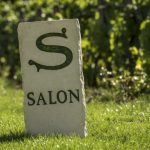
Már ekkor megjelent a márkára jellemző S betű, bár formája és grafikai kialakítása eltért a később ismert változatoktól.
Az eredeti arculat több mint fél évszázadon keresztül alapvetően meghatározta a márka megjelenését.
Az 1971-es változás
Az 1971-es évjáratnál új palackformát vezettek be, és a címkét is jelentősen áttervezték.
A grafikai megjelenés hangsúlyosabb, art deco jellegű S betűt kapott.
A történeti dokumentáció szerint az 1971-es és az 1973-as évjáratot a régi és az új palackformában egyaránt forgalmazták.
Ez gyűjtői szempontból különösen fontos, mert ugyanabból az évjáratból többféle eredeti, gyárilag használt palackváltozat létezhet.
Az 1982-es zöld címke
A Salon ma ismert sötétzöld címkéje 1982-ben jelent meg.
A márkanév megjelenése fokozatosan egyszerűsödött, és a korábban használt „A. Salon” jelölés helyett előtérbe került az önálló „Salon” név.
A későbbi változatoknál a sötétzöld háttér, az aranyszínű stilizált S betű és a visszafogott tipográfia vált meghatározóvá.
A címketörténet tehát három fontos korszakra bontható: az eredeti, 1905-től alkalmazott megjelenésre, az 1971-ben bevezetett áttervezésre és az 1982-től ismert zöld címkés arculatra.
A régi Salon palackok értékelésénél emiatt nemcsak az évjáratot, hanem a palackformát és a címkeváltozatot is figyelembe kell venni.
Forrás: Club Oenologique, Adam Lechmere, 2024. január 23. [4].
A történelmi palackkészlet
A Salon ritkaságát jól mutatják a ház saját pincéjében fennmaradt korai évjáratok.
Audrey Campos, a Salon márkafejlesztési vezetője a Club Oenologique 2024-es cikkében beszámolt a történelmi készletről.
A nyilatkozat szerint a pezsgőház akkor egyetlen 1921-es palackot, két 1928-as palackot és négy 1943-as palackot őrzött.
Az 1930-as évekből nem maradt meg palack a ház saját készletében.
Ezek az adatok a 2024-es vállalati nyilatkozat időpontjára vonatkoznak, nem a világon összesen fennmaradt példányokra.
A történelmi készlet jelentősége több szempontból is fontos.
A régi palackok lehetőséget adnak a borászati stílus több évtizedes fejlődésének vizsgálatára, a korabeli palackok és címkék tanulmányozására, valamint az egyes évjáratok érlelési potenciáljának értékelésére.
A fennmaradt mennyiségek alacsony száma a gyűjtői kereslet szempontjából is meghatározó.
Forrás: Club Oenologique [4].
Didier Depond és a hosszú távú tervezés
Didier Depond 1997 óta vezeti a Champagne Salon és a Champagne Delamotte házakat.
A Club Oenologique interjújában külön hangsúlyozta, hogy a Salon működésében rendkívül hosszú időtávban kell gondolkodni.
Elmondása szerint a pincékben már a 2024-es interjú idején is olyan évjáratok érlelődtek, amelyeket a következő tizenöt év során kívántak forgalomba hozni.
Ez a tervezési szemlélet eltér a legtöbb borászati vállalkozás rövidebb kereskedelmi ciklusától.
A Salon esetében egy évjárat piaci megjelenése akár több mint egy évtizeddel is követheti a szüretet.
A döntések jelentős részét ezért olyan borokra hozzák meg, amelyek csak jóval később kerülnek a fogyasztókhoz.
A klímaváltozás hatása
Depond a 2024-es interjúban a klímaváltozás hatásairól is beszélt.
Megfigyelése szerint a Chardonnay szüretének kezdete korábban gyakran szeptember közepére vagy végére esett, az utóbbi években azonban sok esetben már augusztus végén megkezdődhet.
A melegebb időjárás gyorsabb szőlőérést eredményezhet, ugyanakkor új növényvédelmi és szőlészeti kihívásokat hoz.
Depond külön említette a mediterrán jellegű növényzet fokozatos megjelenését és az új rovarfajok terjedését.
A változó éghajlat miatt a termelőknek egyre nagyobb figyelmet kell fordítaniuk a szőlő egészségi állapotára, a vízellátottságra és a szüret megfelelő időpontjának meghatározására.
Depond ugyanakkor nem számított arra, hogy a Salon a következő évtizedekben lényegesen gyakrabban fog évjáratokat megjelentetni.
A szigorú szelekciót továbbra is a márka egyik meghatározó alapelvének tekintette.
Forrás: Club Oenologique, Didier Depond interjúja [4].

A Champagne Salon a nemzetközi aukciókon
A Champagne Salon régebbi évjáratai rendszeresen megjelennek a nemzetközi boraukciókon.
A gyűjtői értéket több tényező befolyásolja.
Ezek közé tartozik az évjárat minősége, az eredetileg készült palackok száma, a fennmaradt példányok ritkasága, a tárolási körülmények, a palack mérete, a címke és a kapszula állapota, valamint a dokumentálható származás.
Az idősebb Salon palackoknál különösen fontos a megfelelő tárolás.
A Champagne összetett, érzékeny bor, amelynek állapotát jelentősen befolyásolhatják a több évtized alatt elszenvedett hőmérséklet-ingadozások.
A magnum palackok iránt általában külön gyűjtői kereslet mutatkozik, részben azért, mert a nagyobb palackméret kedvezőbb érlelési körülményeket biztosíthat.
A Pandolfini 2015. december 11-i aukciója
A Champagne Salon gyűjtői piacának egyik dokumentált példája a Pandolfini Casa d’Aste 2015. december 11-én megrendezett milánói boraukciója.
Az esemény helyszíne a Centro Svizzero volt.
Az aukcióhoz a Salon és a Delamotte pezsgőházak részvételével szakmai kóstoló és beszélgetés is kapcsolódott.
A rendezvényen Didier Depond, a két pezsgőház vezetője is részt vett.
A kóstolón többek között Salon 2002, 1997 és 1983, valamint Delamotte 1999 és 1970 évjáratú pezsgőket mutattak be.
A Pandolfini hivatalos eredményközlése szerint az aukción a tételek 99%-a elkelt, az összesített értékesítés pedig 420 000 eurót tett ki.
A 4. aukciós tétel egy 1971-es Champagne Salon magnum volt.
A palack 6390 euróért kelt el.
Ez a pontos, az aukciósház által dokumentált eredmény.
Egyes későbbi cikkek tévesen 6930 eurót említenek, de a Pandolfini eredeti eredményközlése 6390 eurót tartalmaz.
Fontos az is, hogy nem 0,75 literes normál palackról, hanem 1,5 literes magnumról volt szó.
Az 1971-es évjárat különösen érdekes a gyűjtők számára, mert az új palackforma és címke bevezetésének időszakához kapcsolódik.
A Pandolfini aukciója így egyszerre szolgáltat dokumentált értékesítési adatot és történeti példát a régi Salon palackok iránti keresletre.
Forrás: Pandolfini Casa d’Aste, hivatalos aukciós eredményközlés, 2015. december 11. [7].
A Salon helye napjaink Champagne-világában
A Champagne Salon mára az egyik legismertebb, korlátozott mennyiségben készülő évjáratos Blanc de Blancs pezsgővé vált.
Különlegessége nem egyetlen technológiai eljárásban rejlik, hanem abban, hogy a termőhelyi, szőlészeti és borászati döntések szinte kizárólag egyetlen borstílus kialakítását szolgálják.
A ház nem készít széles termékkínálatot, nincs minden évben megjelenő nem évjáratos pezsgője, és nem igyekszik a különböző évjáratok karakterét egységessé tenni.
A termelés alapja továbbra is egyetlen Grand Cru település Chardonnay szőlője.
A borokat hosszú ideig érlelik, majd csak megfelelő fejlettségi állapotban hozzák forgalomba.
Az elmúlt több mint száz év alatt a szőlőterületek egy része megváltozott, a technológia fejlődött, és a címkék is több alkalommal módosultak.
A vállalat tulajdonosai szintén változtak, a kezdeti családi vállalkozástól a Besserat de Bellefon és a Pernod Ricard időszakán át a Laurent-Perrier csoportig.
A meghatározó elképzelés azonban fennmaradt.
A Salon hosszú távú jelentőségét éppen az adja, hogy a termelő következetesen ugyanarra a termőhelyi és borászati koncepcióra épít, és a mennyiséget alárendeli az évjáratok kiválasztásának.
Összegzés
A Champagne Salon története egyszerre kapcsolódik a francia pezsgőkészítés fejlődéséhez, a párizsi gasztronómiához, a második világháborúhoz és a nemzetközi borgyűjtés világához.
Eugène-Aimé Salon 1905-ben olyan pezsgőt alkotott, amely egyetlen termőhely, egyetlen szőlőfajta és egyetlen évjárat sajátosságait kívánta megmutatni.
A vállalkozás az 1920-as években került kereskedelmi forgalomba, és a párizsi Maxim’s étterem révén vált szélesebb körben ismertté.
A második világháború idején Salon pezsgők is a német megszállók kezére kerültek. Az elrabolt készletek egy részét Bernard de Nonancourt 1945-ben, francia katonaként találta meg Berchtesgaden térségében.
A későbbi vállalatvezető 1988-ban, immár a Laurent-Perrier csoport élén, megvásárolta a Champagne Salont.
A felvásárlás után a márka nemzetközi pozíciója fokozatosan megerősödött. Az a pezsgő, amelyet a Pernod Ricard korszakában egyes éttermeknek még ingyen adtak más termékek mellé, napjainkra jelentős gyűjtői értéket képvisel.
A borászati alapelvek közben nagyrészt fennmaradtak, de a termőhelyek története, a technológia és az arculat is változott.
A 37 huszadik századi évjárat, a korlátozott palackszám, az átlagosan tízéves érlelés és a következetes termőhelyi szelekció együtt teszik a Salont a Champagne történetének egyik legfontosabb, önálló karakterű pezsgőjévé.
Forrásjegyzék
Hivatalos vállalati és intézményi források
[1] Champagne Salon – Hivatalos honlap és történet
Az alapító története, az 1905-ös első évjárat, az 1920-as alapítás, a húsz parcella, a tízéves átlagos érlelés, a 37 huszadik századi évjárat és a 2015-ös, 45. megjelent évjárat dokumentációja.
https://www.champagne-salon.fr/en
[2] Groupe Laurent-Perrier – Annual Report 2011–2012
A vállalat francia pénzügyi felügyelethez benyújtott éves jelentése. Az 5. oldal Bernard de Nonancourt háborús szolgálatát és a berchtesgadeni Salon-készletek felfedezését ismerteti. A dokumentum a vállalatfelvásárlásra és a cégcsoport történetére is kitér.
https://www.finance-groupelp.com/sites/files/lpfinances/publications/2012/20120611_DDR-2012_en.pdf
[3] Union des Maisons de Champagne – Chronologie des évènements: Champagne Salon
A Salon történeti kronológiája, benne az 1928-as Maxim’s kapcsolattal, az 1963-as és 1976-os tulajdonosváltásokkal, valamint az 1988. szeptember 29-i felvásárlás pontos dátumával.
https://maisons-champagne.com/fr/encyclopedies/chronologie-des-evenements/?id_maison=33
[5] Champagne Delamotte – Delamotte’s Story
A Delamotte hivatalos vállalattörténete, a de Nonancourt család kapcsolata és a Salon–Delamotte együttműködés.
https://www.champagne-delamotte.com/en/page/story
[6] Union des Maisons de Champagne – Champagne Delamotte kronológia
A Delamotte 1939-es családi megszerzése és az 1989-re datált csoporton belüli felvásárlás története.
https://maisons-champagne.com/fr/encyclopedies/chronologie-des-evenements/?id_maison=56
[7] Pandolfini Casa d’Aste – Esito asta vini pregiati e da collezione, 11 dicembre 2015
Az aukciósház eredeti eredményközlése. A dokumentum tartalmazza az 1971-es Salon magnum 6390 eurós értékesítési eredményét.
https://www.pandolfini.it/it/press/esito-asta-vini-pregiati-e-da-collezione-11-dicembre-.asp
Eredeti hivatalos sajtóközlemény PDF formátumban:
https://www.pandolfini.it/uploads/files/1109uk-C.S_ESITO_Pandolfini_Asta_11dicembre2015.pdf
[8] Krug / Moët Hennessy – The Story of Krug
A Krug hivatalos vállalattörténete, amely dokumentálja a Le Mesnil-sur-Oger-i szőlőterületek 1971-es megvásárlását.
https://www.moethennessyjapan.com/en/brands/krug/history
[16] Dokumentation Obersalzberg – Die ehemalige Ausstellung im Kehlsteinhaus
Történeti intézményi forrás a Kehlsteinhaus építéséről, rendeltetéséről, az 1834 méteres magasságról és a Hitler ötvenedik születésnapjához kapcsolódó történeti tévedésről.
https://obersalzberg.de/ausstellungen/ausstellung-im-kehlsteinhaus-dokumentation-obersalzberg
[20] Champagne Laurent-Perrier – Our History
A Laurent-Perrier hivatalos vállalattörténete, az 1812-es eredettől Marie-Louise de Nonancourt 1939-es vásárlásán át Bernard de Nonancourt vezetői pályafutásáig.
https://www.laurent-perrier.com/en/the-maison/history
Borászati és történeti szakforrások
[4] Adam Lechmere – Behind the Bottle: Salon Champagne
Club Oenologique, 2024. január 23.
Didier Depond és Audrey Campos személyes nyilatkozatai; a korai kereskedelmi történet; a Maxim’s 1928-as étlapja; a Krug Clos du Mesnil kapcsolata; az ingyen adott Salon palackok; a borászati technológia; a címkék változásai; a történelmi palackkészlet és a klímaváltozás.
[9] La Fête du Champagne – Salon
Peter Liem Champagne-szakmai ismertetője. A termőhelyek, a körülbelül tizenkét hektáros szőlőterület, a szőlőbeszerzés és a gyártási gyakorlat forrása.
https://www.lafeteduchampagne.com/attending-producers/salon
[11] Charles Curtis MW – Champagne Salon vertical: 1982–2008
Decanter, 2021. szeptember 22.
A Salon korai története, az eredeti Jardin de Salon mérete, a Krug Clos du Mesnil kapcsolata és a Le Mesnil-sur-Oger-i Chardonnay stílusa.
https://www.decanter.com/premium/champagne-salon-vertical-1982-2008-465321
[12] Decanter – Delamotte & Salon Champagne Masterclass, DFWE New York 2026
A 45 megjelent évjárat, a 2014-es és 2015-ös évjárat eltérő érlelési ideje, valamint a Salon és a Delamotte borászati különbségei.
[13] Jean-Claude Ribaut – Bernard de Nonancourt
Le Monde, 2010. november 13.
Bernard de Nonancourt nekrológja, amely felidézi a berchtesgadeni borospince 1945-ös leltározását és a Laurent-Perrier történetét.
https://www.lemonde.fr/disparitions/article/2010/11/13/bernard-de-nonancourt_1439518_3382.html
[14] Sébastien Lapaque – Les vins de France à l’épreuve de l’occupation allemande
La Revue du vin de France.
A második világháború idején eltulajdonított francia borok története, köztük az 1928-as Champagne Salon készleteié.
https://www.larvf.com/les-vins-de-france-a-l-epreuve-de-l-occupation-allemande,4825535.asp
[15] The National WWII Museum – Million Dollar Hangover: Victory Celebration at Berchtesgaden
A Berchtesgaden környékén felfedezett borkészletek és a körülbelül félmillió palackos történeti becslés.
https://www.nationalww2museum.org/war/articles/victory-in-europe-celebration-berchtesgaden
[17] Word on the Grapevine – Distilling Krug’s Clos du Mesnil with chef de cave Julie Cavil
2025. augusztus 28.
A Krug Clos du Mesnil területének története, a Tarin család, a Salon korábbi szőlőbeszerzése és az 1971-es Krug-felvásárlást követő átmeneti időszak.
[18] Antonio Galloni – Salon 2008
Vinous, 2019.
A 2008-as Salon 8000 magnum palackos termelése és az Oenothèque gyűjtői összeállítás részletei.
https://vinous.com/producers/salon–2?article_id=2257
[19] Das Kehlsteinhaus – Inside and Around the Kehlsteinhaus; Tunnel and Elevator
A Sasfészek építészeti részleteinek, a sárgaréz felvonónak és Mussolini vörösmárvány kandallóajándékának történeti ismertetése.
A felhasznált források közül különösen fontos a Laurent-Perrier hivatalos éves jelentése, a Champagne-házak hivatalos kronológiája és a Pandolfini eredeti aukciós közleménye. Ezek a háborús történet, az 1988-as felvásárlás és az aukciós ár legfontosabb közvetlen dokumentumai. finance-groupelp.com+2

Champagne Salon – The History of a Champagne House from 1905 to the Present Day

Eugène-Aimé Salon’s vision, Chardonnay from Le Mesnil-sur-Oger, the story of stolen Champagne, Bernard de Nonancourt and the Laurent-Perrier Group – more than 120 years of Champagne history.
A Champagne That Challenged Tradition
The history of Champagne Salon began in 1905, when Eugène-Aimé Salon created a Champagne that was fundamentally different from the established practices of the time.
At the beginning of the 20th century, the major Champagne houses generally produced their wines by blending different grape varieties, vineyards and vintages. The purpose of this practice was to maintain a consistent house style despite variations in growing conditions from year to year.
Eugène-Aimé Salon, however, wanted to build his Champagne around a single grape variety, vineyards from a single village and the harvest of a single vintage.
He believed that Chardonnay from Le Mesnil-sur-Oger, in the Côte des Blancs, was capable of producing an exceptional, complex and long-lived Champagne on its own.
The first Salon vintage was produced in 1905. Initially, it was not intended for commercial sale but for the founder’s personal consumption and for his friends and guests.
Champagne Salon subsequently became one of the most important historical pioneers of Blanc de Blancs Champagne made exclusively from Chardonnay.
The house continues to follow the fundamental principles of its founder’s original vision: it produces just one vintage Champagne, made exclusively from Chardonnay grown in Le Mesnil-sur-Oger, and only when the quality of the harvest meets its demanding standards.
Sources: Champagne Salon official history [1]; Decanter [11].
Eugène-Aimé Salon – From the Fur Trade to Champagne
Eugène-Aimé Salon was born in 1867 in Pocancy, in the Champagne region of France.
His family was involved in agriculture, but as a young man he moved to Paris, where he began working in the fur industry.
He built his career at Chapal, a fur manufacturing and trading company. Thanks to his business success and international connections, he gradually became a well-known figure in Parisian society.
He travelled regularly, developed an interest in gastronomy and particularly appreciated fine wines.
Although he lived in Paris, he maintained close ties with Champagne. When he decided to create his own Champagne, he sought the assistance of his brother-in-law, Marcel Guillaume.
Guillaume was an experienced cellar master who knew the vineyards of the Côte des Blancs exceptionally well. Together, they investigated which sites were best suited to producing Chardonnay Champagne intended for extended ageing.
They eventually selected Le Mesnil-sur-Oger.
Salon’s concept was unusual because many winemakers at the time believed that Pinot Noir was better suited to long ageing. Chardonnay was often considered too acidic and less capable of producing wines with sufficient structure and longevity.
Salon set out to demonstrate precisely the opposite.
He believed that Chardonnay from the right terroir could develop remarkable complexity, texture and structure through prolonged ageing, without the addition of other grape varieties.
The first vintage, produced in 1905, was followed by further experiments. These early bottles were made in extremely limited quantities and were not commercially available.
In 1911, Salon purchased his own vineyard in Le Mesnil-sur-Oger. This became the vineyard later known as Le Jardin de Salon.
Salon died in 1943.
Sources: Champagne Salon [1]; La Fête du Champagne / Peter Liem [9]; Decanter [11]; Club Oenologique [4].
The First Vintages and Commercial Launch
According to Champagne Salon’s official history, the first vintage was produced in 1905, while the business was formally established in 1920 for commercial purposes.
There are minor discrepancies in the specialist literature concerning the exact chronology of the first commercially released Salon Champagnes.
Peter Liem’s Champagne reference material and several other sources identify the 1921 vintage as the first commercially produced Salon. The official Champagne Salon website places the commercial introduction more generally in the 1920s.
The dates should therefore be distinguished: 1905 marks the first vintage produced, 1920 the formal establishment of the company, and the 1920s the period when the Champagne entered the commercial market.
The Maxim’s Wine List – 1928
One of the most interesting surviving documents from Salon’s early history is a 1928 wine list from the famous Parisian restaurant Maxim’s.
Adam Lechmere discusses this historical document in his article published by Club Oenologique on January 23, 2024.
The wine list features the 1921 Salon vintage under the following description:
Salon & Cie, Mesnil Nature, Cuvée Pure de Raisins Blancs 1921, Vin de Grand Cru (Blanc de Blancs).
This historical designation is significant because it demonstrates that the term “Blanc de Blancs” was not yet as widely used as it is today.
The document also provides evidence of Salon’s presence in prestigious Parisian gastronomy.
According to the historical chronology published by the Union des Maisons de Champagne, Salon became the house Champagne at Maxim’s in 1928, receiving a prominent position on the restaurant’s wine list.
During the interwar years, Maxim’s was one of the best-known restaurants in Paris. Salon’s presence there played an important role in establishing its international reputation.
Sources: Club Oenologique [4]; Union des Maisons de Champagne [3].
Le Mesnil-sur-Oger – The Importance of Terroir
Salon is produced exclusively from grapes grown in Le Mesnil-sur-Oger, a village in the Côte des Blancs.
The village is classified as Grand Cru and is regarded as one of Champagne’s most distinguished Chardonnay-growing locations.
Its characteristic chalky limestone soils play an important role in shaping the structure of the wines.
The deep chalk layers can retain water while also providing effective drainage. This is particularly important during periods of limited rainfall.
Chardonnay from the area is known for its pronounced acidity, citrus and green apple aromas, and a distinctive chalky, often saline character.
These qualities make the wines particularly well suited to extended bottle ageing.
One of Salon’s fundamental principles is that it does not blend grapes from different villages. All of its Chardonnay comes exclusively from Le Mesnil-sur-Oger.
The Twenty Vineyard Parcels
According to Champagne Salon’s official information, the wine currently comes from twenty carefully selected vineyard parcels.
The best known is Le Jardin de Salon, located close to the Champagne house itself.
The estate describes this as an approximately one-hectare vineyard under its direct ownership. A more detailed historical account published by Decanter refers to an original area of 0.77 hectares.
Grapes from the other nineteen parcels are sourced through long-term relationships with contracted growers.
According to Peter Liem’s specialist account, the vineyards supplying Salon cover approximately twelve hectares in total, with a substantial proportion of vineyard work supervised by Salon’s own team.
Le Jardin de Salon was most recently replanted in 2002.
The house’s long-standing relationships with its selected vineyard parcels are particularly important in maintaining a consistent style.
However, the precise composition of the vineyards has not remained entirely unchanged throughout the past century.
Sources: Champagne Salon [1]; La Fête du Champagne / Peter Liem [9]; Decanter [11]; Club Oenologique [4].

The Shared History of Salon and Krug Clos du Mesnil
The history of Salon’s vineyard sources includes one of the most interesting changes in Champagne’s vineyard ownership.
The 1.84-hectare walled Chardonnay vineyard now known as Krug Clos du Mesnil once supplied grapes used in Salon.
The vineyard belonged to the Tarin family, and Eugène-Aimé Salon had purchased grapes from this site since the early years of his Champagne production.
According to the historical account published by Club Oenologique, Clos du Mesnil was among the vineyard parcels originally selected for Salon.
In 1971, the Krug Champagne house purchased Clos du Mesnil.
The acquisition date is also confirmed by Krug’s corporate history.
However, the change in ownership did not necessarily bring an immediate end to Salon’s access to the grapes.
According to Decanter and later specialist accounts involving Krug’s cellar master, fruit from Clos du Mesnil may still have contributed to the 1976 Salon vintage.
Krug began treating the vineyard as the source of its own distinctive single-vineyard Champagne towards the end of the 1970s.
The first Krug Clos du Mesnil was produced from the 1979 vintage and commercially released in 1986.
Today, Krug Clos du Mesnil is one of the house’s most celebrated single-vineyard vintage Champagnes.
The histories of the two houses are therefore connected not only geographically, but also through the earlier use of the same vineyard.
This relationship also qualifies the frequently repeated claim that Salon has used precisely the same twenty vineyard parcels without interruption since 1905.
The continuity of its terroir-focused philosophy remains intact, but the composition of its vineyard sources has evolved over time.
Sources: Club Oenologique [4]; Krug / Moët Hennessy corporate history [8]; Decanter [11]; Word on the Grapevine, 2025 [17].
Champagne Production Techniques
Champagne Salon produces exclusively vintage Blanc de Blancs Champagne.
The wine is made from 100% Chardonnay, and each release comes entirely from a single harvest.
No other grape varieties are used, and reserve wines from previous vintages are not blended into the final wine.
The grapes are harvested at an appropriate stage of ripeness, with particular attention paid to the balance between acidity, sugar levels and aromatic maturity.
After pressing, the highest-quality juice fraction is selected for the base wine.
Fermentation in Stainless Steel
Champagne Salon has used stainless steel tanks for primary fermentation since the early 1980s.
In his interview with Club Oenologique, Didier Depond explained that he and former winemaker Alain Terrier did not consider oak fermentation appropriate for Salon’s style.
In their view, oak could obscure the freshness and purity of aromas they wanted to preserve.
Fermentation in stainless steel allows precise temperature control and helps retain the original aromatic character of Chardonnay.
This also provides an important example of how Salon’s fundamental production philosophy has remained consistent for more than a century, even though its technology has evolved.
Avoiding Malolactic Fermentation
One of the defining technical characteristics of Salon production is that the base wine does not undergo malolactic fermentation.
In many other wines, this process converts part of the sharper malic acid into softer lactic acid, generally producing a rounder perception of acidity.
Salon deliberately preserves the wine’s original acid structure.
The house regards this pronounced, firm acidity as essential to its extended ageing potential and desired style.
Secondary Fermentation in Bottle
The base wine is bottled according to the traditional Champagne method.
A mixture of yeast and sugar, known as liqueur de tirage, is added before the bottle is sealed. During secondary fermentation, the yeast converts the sugar into alcohol and carbon dioxide.
Because the bottle is sealed, the carbon dioxide remains dissolved in the wine, creating Champagne’s characteristic bubbles.
Following secondary fermentation, the wine remains in contact with the spent yeast cells, or lees, for an extended period.
Ageing – An Average of Ten Years in the Cellar
According to Champagne Salon’s official information, the wines spend an average of ten years ageing in the cellar.
This does not mean that every vintage is released after exactly ten years.
Some vintages require considerably longer, and the house decides when to disgorge and release each wine according to its development.
During prolonged lees ageing, the gradual breakdown of yeast cells can contribute to increasingly complex aromas, a finer texture and greater depth.
The natural acidity of Chardonnay from Le Mesnil-sur-Oger is a crucial factor in enabling this extended maturation.
At the end of the ageing period, the sediment is collected in the neck of the bottle and removed through disgorgement.
Dosage – A Restrained Addition of Sugar
Salon traditionally uses a relatively low dosage, meaning that only a limited quantity of expedition liqueur is added after disgorgement.
In his Club Oenologique interview, Didier Depond referred to a dosage of 5–7 grams per litre.
This allows the wine to retain its firm acidity while providing sufficient balance.
The resulting Champagne typically displays citrus, white flower and chalky-saline characteristics in its youth. With further ageing, it may develop more complex notes of toast, honey and mature fruit.
Sources: Champagne Salon [1]; Club Oenologique, interview with Didier Depond [4]; Decanter [11].

Production – Few Vintages and Limited Quantities
One of Champagne Salon’s most important characteristics is that it is not produced every year.
The house releases Salon only when the quality of the grapes and the structure of the wine meet its long-term standards.
Only 37 Salon vintages were produced during the 20th century.
This represents an average of just 3.7 vintages per decade.
Eight vintages from the first quarter of the 21st century had been commercially released under the Salon name: 2002, 2004, 2006, 2007, 2008, 2012, 2013 and 2015.
According to the house’s official records, Salon 2015 represents the 45th released vintage.
Production volumes vary considerably between vintages.
According to Club Oenologique and other specialist sources, even a relatively large vintage typically produces no more than approximately 60,000 standard bottles.
This is not a fixed annual production figure, nor does it mean that every vintage reaches this volume.
Actual quantities are frequently much smaller.
The Exceptional 2008 Vintage
Salon 2008 provides one of the clearest examples of how dramatically production can differ from the usual pattern.
The house produced just 8,000 magnum bottles of this vintage.
The wine was bottled exclusively in the 1.5-litre magnum format and released as part of a special collectors’ presentation.
The so-called Salon Le Mesnil Oenothèque Case contained one magnum of Salon 2008, together with two standard bottles each of the 2004, 2006 and 2007 vintages.
The house justified the exclusive use of magnums by referring to the slower, more balanced maturation that larger bottles can provide.
The Different Release Schedules of the 2014 and 2015 Vintages
According to a Decanter specialist report published in 2026, the 2014 Salon vintage required a longer period on the lees, so the house released the 2015 vintage first.
This is an unusual, though not unprecedented, decision in Salon’s history.
The 2012, 2013, 2014 and 2015 vintages together form an exceptional sequence. A comparable series of four consecutive Salon vintages had previously occurred only between 1946 and 1949.
The different ageing periods demonstrate that Salon’s release schedule is not determined simply by the calendar, but by the development of each individual wine.
What Happens to the Grapes in Years When Salon Is Not Produced?
In years when no Salon is made, grapes from the selected vineyards may be used in other Champagnes.
The most important destination is Champagne Delamotte, which operates in the same village and belongs to the Laurent-Perrier Group.
Some of the fruit may be used for Delamotte Champagnes, while other quantities may be incorporated into additional wines within the group.
This arrangement means that Salon is not obliged to release a Champagne under its own name every year.
Sources: Champagne Salon official vintage records [1]; Club Oenologique [4]; Decanter, 2026 [12]; Vinous [18]; La Fête du Champagne [9].

The Second World War – The Stolen Champagne Salon
One of the most fascinating, and frequently misunderstood, chapters in Champagne Salon’s history is connected with the Second World War.
Following the German occupation of France in 1940, Nazi authorities appropriated substantial quantities of French wine and Champagne.
The valuable stocks of Bordeaux, Burgundy and Champagne were particularly attractive to the German military and occupation authorities.
Champagne Salon did not escape these requisitions.
The central figure in the later story was Bernard de Nonancourt, who would become one of Laurent-Perrier’s most influential leaders after the war.
Bernard de Nonancourt’s Military Service
Bernard de Nonancourt was born in 1920.
His mother, Marie-Louise de Nonancourt, purchased the Laurent-Perrier Champagne house in 1939.
After the outbreak of the Second World War, Bernard and his elder brother Maurice became involved in the French Resistance.
Maurice was captured by the Germans and died in the Sachsenhausen-Oranienburg concentration camp.
Bernard survived the war and subsequently served in General Philippe Leclerc’s renowned French 2nd Armoured Division.
According to Laurent-Perrier’s official annual report, he held the rank of sergeant in the 501st Tank Regiment.
In May 1945, his unit arrived in the Berchtesgaden area, where Adolf Hitler maintained his Bavarian residences and several Nazi leadership facilities were located.
The Discovery of the Berchtesgaden Wine Cellar
The story is described in detail on page 5 of Laurent-Perrier’s official 2011–2012 Annual Report.
According to the document, Bernard de Nonancourt was assigned to inventory Adolf Hitler’s private wine cellar in Berchtesgaden because of his origins in Champagne and his knowledge of wine.
Inside the cellar, he discovered several hundred cases of Champagne Salon.
The company’s account states that these included cases whose confiscation he had personally witnessed five years earlier.
The story is supported by other French sources.
Le Monde’s obituary of Bernard de Nonancourt, published on November 13, 2010, mentions that he participated in the inventory of Hitler’s private wine cellar in Berchtesgaden on May 4, 1945.
A historical account published by La Revue du vin de France refers to several hundred cases of 1928 Salon Champagne that were taken in 1940 and rediscovered in 1945.
The historical foundation of this episode is therefore well established.
Nevertheless, the surviving accounts do not agree on every detail, and the precise number of cases and the full circumstances of the discovery cannot be reconstructed with absolute certainty.
Sources: Laurent-Perrier Annual Report 2011–2012, page 5 [2]; Le Monde [13]; La Revue du vin de France [14].
Hitler’s Eagle’s Nest and the Historical Legend
Accounts of the discovery of Salon Champagne frequently identify Hitler’s Eagle’s Nest, known in German as the Kehlsteinhaus, as the location.
The building stands near Berchtesgaden in the Obersalzberg area, at an altitude of 1,834 metres above sea level, or approximately 6,017 feet.
The Kehlsteinhaus was constructed between 1937 and 1938 at the initiative of Martin Bormann.
It was conceived as a prestigious reception building intended to impress senior visitors, diplomats and foreign guests.
A dedicated mountain road, a tunnel excavated into the rock and an elevator were constructed to provide access to the building.
The tunnel was approximately 126 metres long, while the elevator travelled vertically through a height of approximately 124 metres.
The elevator interior was fitted with polished brass panels, mirrors and leather-covered seating.
Mussolini’s Gift
One frequently repeated story claims that Benito Mussolini gave the elevator to Hitler as a present.
This is incorrect.
Mussolini’s gift was the fireplace made of red Carrara marble in the Kehlsteinhaus, not the elevator.
Hitler’s Fiftieth Birthday
The Kehlsteinhaus is often described as a gift presented to Hitler for his fiftieth birthday on April 20, 1939.
However, research by the historical institution Dokumentation Obersalzberg indicates that surviving primary sources do not substantiate this popular claim.
The building had already been completed and handed over in mid-1938. Historians therefore do not consider the birthday-gift story to be firmly established.
Hitler himself rarely used the building. Historical records document approximately fourteen visits.
His actual residence at Obersalzberg was the Berghof, situated further down the mountain.
The 500,000-Bottle Wine Collection
Accounts of the Berchtesgaden wine cellar frequently refer to a collection containing half a million bottles.
According to the American National WWII Museum, French troops discovered a vast stock of wine and Champagne in May 1945, estimated at approximately 500,000 bottles.
The collection included valuable French wines, Champagnes and cognacs.
However, the figure of half a million should be treated as an estimate, since no complete contemporary inventory has been identified that independently verifies every bottle.
Caution is also necessary regarding the precise location.
Some recollections associate the discovery with the Kehlsteinhaus itself, while others refer more generally to Hitler’s private wine cellar in Berchtesgaden.
Laurent-Perrier’s official corporate documentation uses the broader description “private wine cellar in Berchtesgaden.”
It is therefore more historically accurate to state that Bernard de Nonancourt participated in the discovery of stolen French Champagnes in the Berchtesgaden area than to categorically place the collection inside the Eagle’s Nest building at the summit.
The story also does not establish that Adolf Hitler personally appreciated or collected Salon Champagne. The presence of the stolen wines was primarily a consequence of requisitions during the occupation of France.
Sources: Laurent-Perrier [2]; National WWII Museum [15]; Dokumentation Obersalzberg [16]; Kehlsteinhaus historical information [19].

Bernard de Nonancourt’s Return to Champagne
After the war, Bernard de Nonancourt returned to the family business.
His mother insisted that he acquire practical experience in every stage of Champagne production before assuming a managerial position.
Bernard therefore worked in vineyards and cellars, including periods at the Lanson and Delamotte Champagne houses.
According to Laurent-Perrier’s official corporate history, he took charge of the company in 1948, at the age of twenty-eight.
At that time, the Champagne house employed approximately twenty people and sold around 80,000 bottles annually.
Under Bernard de Nonancourt’s leadership, Laurent-Perrier gradually became one of Champagne’s major international producers.
Important developments included temperature-controlled fermentation, broader use of stainless steel tanks and the creation of premium Champagne cuvées.
Laurent-Perrier introduced its Grand Siècle prestige cuvée in 1958, followed by Cuvée Rosé Brut in 1968.
Alongside international expansion, Bernard de Nonancourt placed particular emphasis on quality and long-term brand development.
The predecessor of Laurent-Perrier was established in 1812 in Tours-sur-Marne by André-Michel Pierlot.
This foundation date belongs to Laurent-Perrier, not to Champagne Salon.
Sources: Laurent-Perrier official history [20]; Laurent-Perrier Annual Report [2].
Changes of Ownership at Champagne Salon
Following Eugène-Aimé Salon’s death in 1943, the Champagne house remained in family ownership for a period, but underwent several changes of ownership in subsequent decades.
According to the official chronology of the Union des Maisons de Champagne, in 1963 Marcel Guillaume, the founder’s grandson, was forced to sell the business because of financial difficulties associated with inheritance taxes.
Champagne Salon was acquired by Besserat de Bellefon, which at the time belonged to Compagnie Générale Dubonnet-Cinzano.
In 1976, the Pernod Ricard Group acquired Besserat de Bellefon and A. Salon et Cie.
This period remains one of the lesser-known chapters in Salon’s history.
Although the Champagne already had a distinguished heritage, its commercial position and international recognition were not comparable with those it would acquire in later decades.
When Salon Champagne Was Given Away to Restaurants
Didier Depond, president of Salon and Delamotte since 1997, recalled a surprising detail from the Pernod Ricard era in his 2024 interview with Club Oenologique.
According to Depond, the company offered certain restaurant customers six or twelve bottles of Salon free of charge when they purchased 100 bottles of Besserat de Bellefon Champagne.
As a young salesman, shortly after Salon entered the Laurent-Perrier Group, Depond visited the Hôtel Raphael in Paris.
When he offered Salon to the sommelier, he was told that the hotel was not accustomed to paying for it.
The restaurant had previously received Salon for free as part of its Besserat de Bellefon purchases.
This anecdote illustrates just how dramatically Champagne Salon’s commercial reputation has changed over the decades.
A Champagne now regarded as a highly valuable collectors’ wine was once used as a promotional incentive.
According to Depond, Pernod Ricard had not fully recognised the value of the brand in its portfolio.
Under Laurent-Perrier ownership, Salon’s brand development increasingly emphasised its rarity, strictly limited production, historical heritage and distinctive winemaking philosophy.
Source: Adam Lechmere, Club Oenologique, January 23, 2024 [4].
The 1988 Acquisition – Salon Joins the Laurent-Perrier Group
The next major turning point in Champagne Salon’s history came in 1988.
The Laurent-Perrier Group, led by Bernard de Nonancourt, acquired the Champagne house.
The official chronology of the Union des Maisons de Champagne records September 29, 1988, as the date of the transaction.
Laurent-Perrier’s corporate reports likewise identify 1988 as the year of the Salon acquisition.
Some later specialist articles give 1989, but the precisely dated professional chronology and original corporate documentation should be regarded as the more authoritative sources.
The acquisition also carried a remarkable personal historical connection.
In 1945, Bernard de Nonancourt had participated as a French soldier in the discovery of stolen Salon Champagne.
Forty-three years later, the company under his leadership acquired Champagne Salon.
Some specialist accounts suggest that the wartime experience may have contributed to his personal interest in the brand.
Both events are documented, but the existence of a direct causal motivation cannot be established with complete certainty.
Following the acquisition, Salon retained its own name, production principles and headquarters in Le Mesnil-sur-Oger.
The Laurent-Perrier Group provided new opportunities through its international distribution network and long-term brand development.
Sources: Union des Maisons de Champagne [3]; Laurent-Perrier [2]; Club Oenologique [4].
The Relationship Between Champagne Delamotte and Salon
The history of Salon is closely connected with Champagne Delamotte.
Founded in 1760 by François Delamotte in Reims, Delamotte is one of the oldest Champagne houses.
The house became associated with the de Nonancourt family during the first half of the 20th century.
According to the Union des Maisons de Champagne chronology, Marie-Louise de Nonancourt acquired the Delamotte Père et Fils brand and its building in Le Mesnil-sur-Oger on May 22, 1939.
The house was subsequently managed by her son, Charles de Nonancourt.
Delamotte’s official corporate history highlights 1988 in relation to its integration into the Laurent-Perrier Group, while the Union des Maisons de Champagne dates the formal acquisition within the group to 1989.
The difference probably reflects the distinction between existing family ownership, organisational integration and the legal date of the transaction.
Since then, the operations of Salon and Delamotte have been closely connected.
Both houses are based in Le Mesnil-sur-Oger, and Chardonnay plays a defining role in their production.
However, their winemaking philosophies differ.
Salon is made only in selected vintages, exclusively from Chardonnay, and does not undergo malolactic fermentation.
Delamotte offers a broader range of Champagnes, producing several different styles and generally allowing malolactic fermentation during winemaking.
Both houses have been led by Didier Depond since 1997, while the winemaking operation is overseen by Michel Fauconnet, cellar master of the Laurent-Perrier Group.
Sources: Champagne Delamotte official history [5]; Union des Maisons de Champagne – Delamotte chronology [6]; La Fête du Champagne [9].


The Evolution of Salon’s Labels and Bottles
It is often claimed that Champagne Salon has used the same label and bottle for more than a hundred years.
This is not historically accurate.
The 2024 Club Oenologique historical study documents the evolution of Salon’s visual identity in considerable detail.
The Original 1905 Label
The first label was designed by Eugène-Aimé Salon himself.
Its appearance was restrained, with simple typography and an emphasis on the Salon name.
The distinctive letter S was already present, although its shape and graphic treatment differed from later designs.
This original visual identity remained the basis of Salon’s presentation for more than half a century.
The 1971 Redesign
With the 1971 vintage, Salon introduced a new bottle shape and substantially redesigned its label.
The new graphic identity featured a more prominent, Art Deco-inspired letter S.
According to historical documentation, the 1971 and 1973 vintages were both released in the original and the redesigned bottle formats.
This is particularly important for collectors because genuine, factory-original bottles from the same vintage can exist in different designs.
The Green Label Introduced in 1982
The dark green label associated with Salon today first appeared in 1982.
The presentation of the brand name gradually became simpler, with the standalone name “Salon” becoming more prominent than the earlier “A. Salon” designation.
Later versions adopted the dark green background, stylised gold S and restrained typography that have become defining features of Salon’s modern identity.
The history of the label can therefore be divided into three principal periods: the original presentation used from 1905, the redesigned identity introduced in 1971 and the green-label design introduced in 1982.
When evaluating older Salon bottles, collectors should therefore consider not only the vintage but also the bottle shape and specific label variation.
Source: Club Oenologique, Adam Lechmere, January 23, 2024 [4].

The Historical Bottle Collection
The rarity of Salon is illustrated by the small number of early vintages remaining in the house’s own cellars.
Audrey Campos, Salon’s brand development manager, discussed the historical collection in the Club Oenologique article published in 2024.
According to her statement, the house then held just one bottle of the 1921 vintage, two bottles of 1928 and four bottles of 1943.
No bottles from the 1930s remained in the house’s own collection.
These figures refer to the company’s cellar holdings at the time of the 2024 statement, not to the total number of surviving bottles worldwide.
The historical collection is significant for several reasons.
Older bottles allow the house to study the development of its winemaking style over decades, examine historical bottle shapes and labels, and evaluate the ageing potential of individual vintages.
The exceptionally small number of surviving bottles also plays an important role in collectors’ demand.
Source: Club Oenologique [4].
Didier Depond and Long-Term Planning
Didier Depond has led Champagne Salon and Champagne Delamotte since 1997.
In his Club Oenologique interview, he emphasised that Salon must operate according to an exceptionally long-term perspective.
According to Depond, at the time of the 2024 interview, the cellars already contained vintages intended for release over the following fifteen years.
This approach differs from the shorter commercial cycles typical of many wine businesses.
For Salon, a vintage may not reach the market until more than a decade after the harvest.
Many decisions are therefore made about wines that consumers will not see for many years.
The Impact of Climate Change
Depond also discussed the consequences of climate change in the 2024 interview.
He noted that Chardonnay harvesting previously often began in mid- or late September, whereas in recent years it has frequently started as early as late August.
Warmer weather can accelerate grape ripening, but it also introduces new challenges in vineyard management and plant protection.
Depond specifically mentioned the gradual appearance of Mediterranean-type vegetation and the spread of new insect species.
Changing climatic conditions require growers to pay increasing attention to vine health, water availability and the precise timing of the harvest.
Nevertheless, Depond did not expect Salon to begin releasing substantially more vintages in the coming decades.
He continued to regard strict vintage selection as one of the brand’s defining principles.
Source: Club Oenologique, interview with Didier Depond [4].

Champagne Salon at International Wine Auctions
Older Champagne Salon vintages regularly appear at international wine auctions.
Their collectors’ value is influenced by several factors.
These include the quality of the vintage, original production quantities, the rarity of surviving bottles, storage conditions, bottle size, label and capsule condition, and documented provenance.
Proper storage is especially important for older Salon bottles.
Champagne is a complex and delicate wine, and its condition can be significantly affected by temperature fluctuations over several decades.
Magnum bottles often command particular interest among collectors, partly because the larger format may provide more favourable conditions for slow, balanced maturation.
The Pandolfini Auction of December 11, 2015
One documented example of the collectors’ market for Champagne Salon is the wine auction held by Pandolfini Casa d’Aste in Milan on December 11, 2015.
The event took place at the Centro Svizzero.
A professional tasting and discussion involving the Salon and Delamotte Champagne houses accompanied the auction.
Didier Depond, president of both houses, participated in the event.
The tasting included Salon vintages 2002, 1997 and 1983, as well as Delamotte 1999 and 1970.
According to Pandolfini’s official results announcement, 99% of the auction lots were sold, achieving a total of €420,000.
Lot 4 was a 1971 Champagne Salon magnum.
The bottle sold for €6,390.
This is the precise result documented by the auction house.
Some later articles incorrectly quote €6,930, but Pandolfini’s original results announcement clearly states €6,390.
It is also important to note that the bottle was not a standard 750 ml format but a 1.5-litre magnum.
The 1971 vintage is particularly interesting to collectors because it coincides with the introduction of Salon’s redesigned bottle and label.
The Pandolfini auction therefore provides both a documented market value and a historical example of demand for older Salon bottles.
Source: Pandolfini Casa d’Aste, official auction results, December 11, 2015 [7].
Champagne Salon’s Position in the Modern Champagne World
Champagne Salon has become one of the most recognised vintage Blanc de Blancs Champagnes produced in limited quantities.
Its distinctive character is not the result of one individual technical procedure, but of a production philosophy in which virtually every vineyard and winemaking decision serves the creation of one particular style.
The house does not maintain an extensive product range, does not produce a non-vintage Champagne for annual release and does not attempt to eliminate differences between vintages.
Its production remains based on Chardonnay from a single Grand Cru village.
The wines undergo extended ageing and are released only when they have reached the appropriate stage of development.
Over more than a century, some of the vineyard sources have changed, technology has evolved, and the labels have been redesigned several times.
Ownership has also changed, from the original family business through the Besserat de Bellefon and Pernod Ricard periods to the Laurent-Perrier Group.
Yet the defining concept has survived.
Salon’s long-term significance lies in its commitment to a consistent terroir-driven and winemaking philosophy, in which production volume remains secondary to the selection of suitable vintages.

Conclusion
The history of Champagne Salon is closely connected with the development of French Champagne production, Parisian gastronomy, the Second World War and the international fine-wine collecting market.
In 1905, Eugène-Aimé Salon created a Champagne intended to express the characteristics of a single terroir, a single grape variety and a single vintage.
The business entered the commercial market during the 1920s and became more widely known through its association with the celebrated Parisian restaurant Maxim’s.
During the Second World War, stocks of Salon Champagne were seized by the German occupiers. Some of these stolen wines were discovered in the Berchtesgaden area in 1945 by French troops, including Bernard de Nonancourt.
In 1988, de Nonancourt, by then head of the Laurent-Perrier Group, acquired Champagne Salon.
Under Laurent-Perrier ownership, the brand gradually strengthened its international position. A Champagne that had once been given away to certain restaurants alongside purchases of other brands developed into a highly valued collectors’ wine.
The fundamental winemaking principles largely survived, although the vineyard sources, production technology and visual identity evolved over time.
The 37 vintages produced during the 20th century, limited bottle quantities, an average ageing period of ten years and strict vineyard and vintage selection have collectively made Salon one of the most distinctive Champagnes in the history of the region.
References and Sources
Official Corporate and Institutional Sources
[1] Champagne Salon – Official Website and History
The founder’s biography, the first vintage of 1905, the establishment of the business in 1920, the twenty vineyard parcels, the average ten-year ageing period, the 37 vintages produced during the 20th century, and the 2015 vintage as the 45th release.
https://www.champagne-salon.fr/en
[2] Groupe Laurent-Perrier – Annual Report 2011–2012
The company’s annual report filed with the French financial authorities. Page 5 describes Bernard de Nonancourt’s military service and the discovery of Salon Champagne stocks in Berchtesgaden. The report also addresses corporate acquisitions and the history of the group.
https://www.finance-groupelp.com/sites/files/lpfinances/publications/2012/20120611_DDR-2012_en.pdf
[3] Union des Maisons de Champagne – Chronologie des évènements: Champagne Salon
The historical chronology of Salon, including its association with Maxim’s in 1928, ownership changes in 1963 and 1976, and the precise date of the acquisition on September 29, 1988.
https://maisons-champagne.com/fr/encyclopedies/chronologie-des-evenements/?id_maison=33
[5] Champagne Delamotte – Delamotte’s Story
Delamotte’s official corporate history, its association with the de Nonancourt family, and the relationship between Salon and Delamotte.
https://www.champagne-delamotte.com/en/page/story
[6] Union des Maisons de Champagne – Champagne Delamotte Chronology
The acquisition of Delamotte by the de Nonancourt family in 1939 and the formal acquisition within the group dated to 1989.
https://maisons-champagne.com/fr/encyclopedies/chronologie-des-evenements/?id_maison=56
[7] Pandolfini Casa d’Aste – Esito asta vini pregiati e da collezione, 11 dicembre 2015
The auction house’s original results announcement, documenting the sale of a 1971 Salon magnum for €6,390.
https://www.pandolfini.it/it/press/esito-asta-vini-pregiati-e-da-collezione-11-dicembre-.asp
Original official press release in PDF format:
https://www.pandolfini.it/uploads/files/1109uk-C.S_ESITO_Pandolfini_Asta_11dicembre2015.pdf
[8] Krug / Moët Hennessy – The Story of Krug
Krug’s official corporate history, documenting its acquisition of vineyards in Le Mesnil-sur-Oger in 1971.
https://www.moethennessyjapan.com/en/brands/krug/history
[16] Dokumentation Obersalzberg – Die ehemalige Ausstellung im Kehlsteinhaus
Institutional historical information concerning the construction and purpose of the Kehlsteinhaus, its altitude of 1,834 metres, and the historical misconception surrounding Hitler’s fiftieth birthday.
https://obersalzberg.de/ausstellungen/ausstellung-im-kehlsteinhaus-dokumentation-obersalzberg
[20] Champagne Laurent-Perrier – Our History
Laurent-Perrier’s official corporate history, from its foundation in 1812 through Marie-Louise de Nonancourt’s purchase in 1939 and Bernard de Nonancourt’s leadership.
https://www.laurent-perrier.com/en/the-maison/history
Wine and Historical Research Sources
[4] Adam Lechmere – Behind the Bottle: Salon Champagne
Club Oenologique, January 23, 2024.
Interviews with Didier Depond and Audrey Campos; Salon’s early commercial history; the 1928 Maxim’s wine list; the relationship with Krug Clos du Mesnil; the practice of giving away Salon bottles; winemaking techniques; label evolution; historical cellar stocks; and climate change.
[9] La Fête du Champagne – Salon
Peter Liem’s specialist account of Champagne Salon, including vineyard sources, the approximately twelve-hectare area supplying grapes, sourcing arrangements and production methods.
https://www.lafeteduchampagne.com/attending-producers/salon
[11] Charles Curtis MW – Champagne Salon Vertical: 1982–2008
Decanter, September 22, 2021.
Salon’s early history, the original size of Le Jardin de Salon, the relationship with Krug Clos du Mesnil, and the distinctive Chardonnay style of Le Mesnil-sur-Oger.
https://www.decanter.com/premium/champagne-salon-vertical-1982-2008-465321
[12] Decanter – Delamotte & Salon Champagne Masterclass, DFWE New York 2026
The 45 released vintages, the different ageing periods of the 2014 and 2015 vintages, and the winemaking differences between Salon and Delamotte.
[13] Jean-Claude Ribaut – Bernard de Nonancourt
Le Monde, November 13, 2010.
An obituary recalling the inventory of the Berchtesgaden wine cellar in 1945 and the history of Laurent-Perrier.
https://www.lemonde.fr/disparitions/article/2010/11/13/bernard-de-nonancourt_1439518_3382.html
[14] Sébastien Lapaque – Les vins de France à l’épreuve de l’occupation allemande
La Revue du vin de France.
The history of French wines seized during the German occupation, including stocks of 1928 Champagne Salon.
https://www.larvf.com/les-vins-de-france-a-l-epreuve-de-l-occupation-allemande,4825535.asp
[15] The National WWII Museum – Million Dollar Hangover: Victory Celebration at Berchtesgaden
The discovery of wine stocks in the Berchtesgaden area and the historical estimate of approximately half a million bottles.
https://www.nationalww2museum.org/war/articles/victory-in-europe-celebration-berchtesgaden
[17] Word on the Grapevine – Distilling Krug’s Clos du Mesnil with Chef de Cave Julie Cavil
August 28, 2025.
The history of the Krug Clos du Mesnil vineyard, the Tarin family, Salon’s earlier grape sourcing, and the transitional period following Krug’s acquisition in 1971.
[18] Antonio Galloni – Salon 2008
Vinous, 2019.
The production of 8,000 magnums of Salon 2008 and details of the Oenothèque collectors’ presentation.
https://vinous.com/producers/salon–2?article_id=2257
[19] Das Kehlsteinhaus – Inside and Around the Kehlsteinhaus; Tunnel and Elevator
Historical information about the Eagle’s Nest, including the brass-lined elevator and the red marble fireplace given by Mussolini.


